Why Buy Bulk Cable Ties for Your Business?

For many businesses, small fastening supplies create surprisingly large operational costs. Bulk cable ties can reduce repeated purchasing, packaging waste, and unexpected maintenance delays. A stocked drawer can keep an installation moving when one missing tie would stop the job.

Consider an electrical contractor managing several sites. Technicians may secure labeled cables, temporary bundles, or lightweight equipment during daily work. Buying larger quantities often improves unit pricing and supports consistent organization. It can also simplify procurement, especially when teams repeatedly use the same size, color, and material. Nylon ties suit many indoor applications, while UV-resistant options may perform better outdoors. The choice matters.

But buying more is not automatically better. Poor sizing, weak locking heads, or unsuitable materials can create waste and rework. I have seen low-cost supplies become expensive after repeated breakage. Storage conditions matter, too. Excess heat, moisture, and sunlight may reduce product reliability before use. Businesses should review actual consumption, working environments, tensile requirements, and supplier quality records before ordering.

A practical bulk strategy balances savings with control. Start with measured demand. Keep common sizes available, but avoid filling shelves with unused variants. Reputable suppliers should provide clear specifications, batch consistency, and responsive support. These details may seem ordinary. They protect workflow reliability. Careful purchasing turns bulk cable ties from a simple commodity into a dependable part of daily operations.
Why Buy Bulk Cable Ties for Your Business?

Understanding Bulk Cable Ties and Their Business Applications

Bulk cable ties are more than low-cost plastic fasteners.

They are repeat-use supplies for electrical panels, warehouse racking, HVAC lines, and temporary cable routing. Grand View Research estimated the global cable ties market at about USD 2.1 billion in 2023, with continued growth expected through 2030. This demand reflects ordinary business needs: securing bundles, reducing trip hazards, and keeping maintenance work consistent.

Buying in bulk can lower unit costs and prevent interruptions during installation. A technician should still check material, width, tensile strength, and temperature resistance before ordering.

Nylon ties suit many indoor tasks, while UV-resistant materials are better for outdoor exposure. Releasable designs may reduce waste during equipment changes. Small details matter. A 200-millimeter tie will not replace a 300-millimeter tie around a thick conduit.

Inventory planning is less simple than filling a shelf.

ASCM supply-chain benchmarks commonly place annual inventory carrying costs near 20% to 30% of inventory value. Excess cartons can consume storage space, absorb moisture, or remain unused after a project changes.

I have seen purchasing decisions focus too heavily on the lowest price. That assumption is incomplete. A better approach compares usage history, pack size, storage conditions, and the cost of emergency orders. IEC 62275 also emphasizes selecting cable ties according to installation conditions and performance requirements, not appearance alone.

Evaluating Cost Savings from Large-Quantity Cable Tie Purchases

Why Buy Bulk Cable Ties for Your Business?

Buying cable ties in larger quantities can reduce unit prices, delivery fees, and emergency purchasing. McKinsey procurement research suggests strategic sourcing can lower purchase costs by 5–15% in suitable categories. Cable ties often fit this model because they are standardized, lightweight, and frequently consumed.

A practical calculation should include more than the invoice price. ASCM inventory guidance commonly estimates annual holding costs at 20–30% of stored inventory value. A $1,000 bulk order could therefore create $200–$300 in yearly carrying costs. Store ties in a dry cabinet, use labeled bins, and measure monthly consumption before increasing volume. Small details matter.

For example, a maintenance team using 2,000 ties monthly may compare three orders of 8,000 units with one order of 24,000. The larger purchase may save 10% per unit, but only if storage remains controlled. Deloitte’s 2023 Global Chief Procurement Officer Survey also highlights cost management and supply resilience as connected priorities. That matters when a production line needs replacements tomorrow. Still, forecasts can be wrong. A product redesign may leave thousands of unused ties. Review size, material, temperature rating, and actual usage history before committing. Bulk purchasing works best when savings are tested against real consumption, not assumed.

Choosing the Right Cable Tie Materials, Sizes, and Features

Why Buy Bulk Cable Ties for Your Business?

Choosing the Right Cable Tie Materials, Sizes, and Features

Buying cable ties in bulk can reduce supply interruptions and simplify routine maintenance. However, volume alone does not guarantee a good purchasing decision. Material selection matters when ties face sunlight, moisture, heat, or chemical exposure. Standard nylon works well for many indoor applications. UV-resistant nylon is more dependable outdoors. Stainless steel ties suit demanding environments, but they cost more and require careful handling.

Size should match the bundle, not merely the shelf space. Measure the cable group before ordering. A tie that barely closes may weaken under tension. An oversized tie can leave waste and create an untidy installation. Check length, width, and rated tensile strength together. I once ordered a wider tie for extra strength, then discovered it did not fit through existing mounting clips. That mistake delayed a small installation.

Useful features can improve daily work. Releasable ties support temporary wiring changes. Identification tags help technicians trace cables inside crowded panels. Smooth edges reduce snagging during installation. For sensitive cables, choose ties that avoid excessive compression. Store bulk packs in a dry area, away from direct sunlight and extreme temperatures. Product specifications and test documents should be reviewed before purchase. A lower unit price is tempting, but unsuitable material creates replacement work. I still find that estimating future usage is imperfect; modest safety stock is usually wiser than filling an entire storeroom.

Why Buy Bulk Cable Ties for Your Business? Choosing the Right Cable Tie Materials, Sizes, and Features

Business Requirement Recommended Material or Type Typical Size Range Key Performance Characteristics Suitable Applications Bulk-Buying Considerations
General indoor cable management Standard nylon 6/6 cable ties 100–300 mm length; 2.5–4.8 mm width
  • Good balance of strength, flexibility, and cost
  • Commonly available in natural or black colors
  • Suitable for normal indoor temperatures
Office wiring, control panels, workstations, retail fixtures, and equipment assembly Usually the most practical bulk option when exposure to sunlight, chemicals, and extreme temperatures is limited.
Outdoor and sunlight exposure UV-resistant black nylon 6/6 cable ties 150–370 mm length; 3.6–7.6 mm width
  • Carbon black helps improve resistance to ultraviolet exposure
  • Better suited to outdoor cable routing than natural nylon
  • Performance depends on the specific grade and installation environment
Outdoor electrical cabinets, solar installations, telecommunications, signage, and building services Buy the UV-resistant version rather than assuming that all black ties have the same outdoor durability.
High-temperature environments Heat-stabilized nylon 6/6 or high-temperature engineering polymer 100–300 mm length; 2.5–4.8 mm width
  • Designed for higher continuous-use temperatures than standard nylon
  • Material ratings vary by formulation and supplier
  • Check the published temperature range before use
Industrial machinery, engine compartments, lighting equipment, and warm production areas Specify the required operating temperature and safety margin; do not select solely by nominal tensile strength.
Exposure to chemicals, oils, or fuels Polypropylene cable ties or chemically resistant specialty polymer ties 100–300 mm length; 2.5–4.8 mm width
  • Polypropylene offers useful resistance to many acids, alkalis, and chemicals
  • Generally has lower stiffness and strength than standard nylon
  • Compatibility must be verified for the exact chemical and concentration
Laboratories, processing equipment, marine areas, chemical handling zones, and agricultural equipment Request a chemical-resistance chart and test samples when the ties will contact aggressive substances.
Moisture-prone or damp locations Polypropylene or moisture-conditioned nylon cable ties 150–300 mm length; 3.6–4.8 mm width
  • Polypropylene absorbs less moisture than nylon
  • Nylon properties can change as it absorbs moisture
  • Neither material should be treated as automatically waterproof in every application
Outdoor service areas, washdown zones, plumbing installations, and damp utility spaces Consider storage conditions as well as service conditions, especially for large inventory purchases.
Heavy cable bundles and industrial assembly Heavy-duty nylon cable ties 300–760 mm length; 7.6–13.0 mm width
  • Higher rated loop tensile strength than standard narrow ties
  • Wider straps distribute load over a larger area
  • Requires sufficient clearance around the bundle for installation
Industrial harnesses, construction equipment, large control systems, and power cable routing Match the tie’s rated tensile strength to the load; avoid using cable ties as a substitute for engineered supports.
Temporary installation or frequent rework Releasable or reusable cable ties 150–300 mm length; 3.6–7.6 mm width
  • Can be opened and reused when the locking mechanism is not damaged
  • Reduces waste during maintenance and prototyping
  • May not provide the same permanent locking security as standard one-piece ties
Service departments, prototypes, testing, event production, and temporary installations Useful for teams that frequently change cable layouts; keep permanent ties available for final installation.
Identification and circuit tracing Colored, writable, or marker-tab cable ties 100–300 mm length; 2.5–4.8 mm width
  • Supports color coding and visual identification
  • Marker tabs provide space for labels or handwritten references
  • Identification improves maintenance efficiency when used consistently
Data centers, electrical panels, production lines, and complex equipment harnesses Buy a planned color mix and define a labeling standard before ordering large quantities.
Vibration-sensitive equipment Locking cable ties with smooth edges or cushioned mounting systems 150–370 mm length; 3.6–7.6 mm width
  • Smooth edges help reduce abrasion when correctly installed
  • Mounting bases can separate cable bundles from sharp or moving surfaces
  • Proper routing and strain relief remain essential
Vehicles, machinery, robotics, electrical enclosures, and mobile equipment Check the mounting-base attachment method and use designs compatible with the surface and vibration level.
Flame-performance requirements Flame-retardant nylon or another polymer with a documented flammability rating 100–300 mm length; 2.5–4.8 mm width
  • May reduce flame spread compared with ordinary nylon
  • Ratings apply only under specified test conditions
  • Does not make the entire cable assembly fireproof
Electrical control equipment, transportation interiors, industrial panels, and regulated installations Request the applicable test standard and certification documents before purchasing in bulk.
Fast installation at high volume Standard one-piece self-locking cable ties 100–300 mm length; 2.5–4.8 mm width
  • Simple installation with minimal tools
  • Compatible with manual or automatic tensioning equipment
  • Consistent dimensions support faster assembly
Manufacturing lines, electrical contracting, warehouse operations, and repetitive assembly Buying cartons or multi-pack quantities can reduce replenishment work and help standardize installation procedures.
Reducing inventory complexity A planned assortment of standard lengths and widths 100, 150, 200, 250, and 300 mm common starting sizes
  • Covers many small and medium cable bundles
  • Standard sizes are easier to store, count, and reorder
  • Specialty sizes can be added after actual usage is reviewed
Maintenance stores, electrical contractors, installers, and multi-site operations Use historical consumption to set minimum and maximum stock levels instead of buying every size in equal quantities.

Selection note: Actual performance depends on the material grade, design, installation method, storage conditions, and exposure environment. Always verify the supplier’s technical data, rated loop tensile strength, operating temperature, and applicable certifications before placing a large order.

Managing Inventory, Storage, and Supply Continuity

Buying cable ties in bulk can protect supply continuity, but only when inventory reflects actual usage. McKinsey Global Institute estimates that companies may face a supply-chain disruption lasting one month or longer every 3.7 years. A small fastening item can therefore delay maintenance when replenishment arrives late. Not always.

Use monthly consumption, project schedules, and supplier lead times to set a minimum stock level. Keep separate quantities for routine work and emergency repairs. MHI’s 2024 Annual Industry Report found that 55% of supply-chain leaders planned to increase technology investment. Even a simple barcode log can improve visibility. Record size, length, material, color, and purchase date. Labels matter.

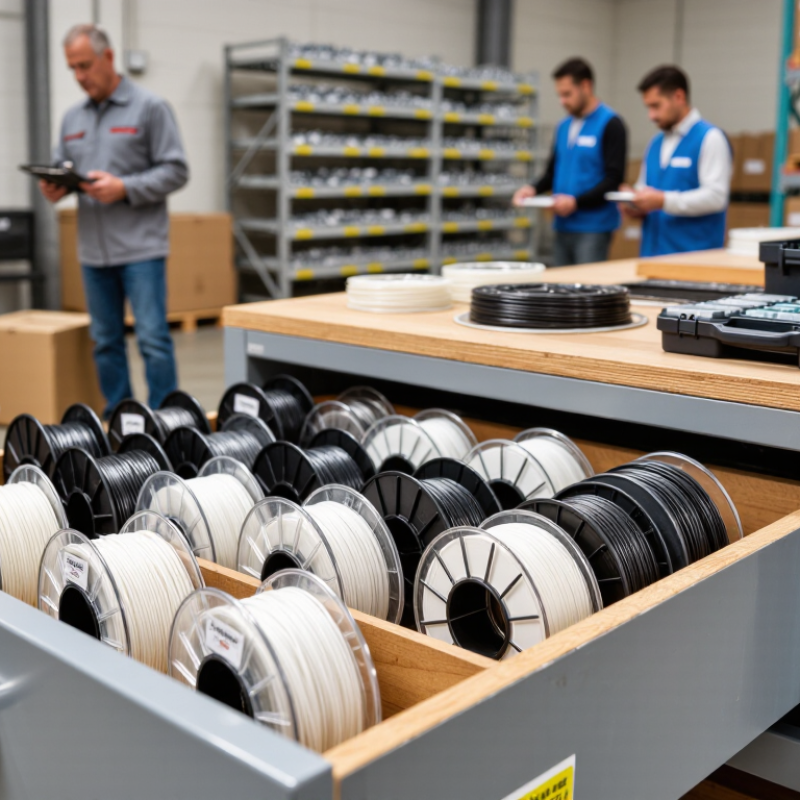
Storage conditions also affect usable inventory. Keep ties in sealed containers, away from direct sunlight, heat, moisture, and chemical vapors. Nylon products can weaken before the packaging looks damaged. Use first-in, first-out rotation, especially for long-held stock. A practical storeroom check should confirm quantity, packaging condition, and product flexibility. I have seen teams count cartons but ignore aging materials. That creates false confidence. Bulk purchasing can lower ordering frequency and reduce urgent freight, yet excessive stock consumes shelf space and cash. Review usage quarterly, then adjust order quantities when projects, staffing, or equipment change. A spreadsheet helps, but it can still lie. Physical checks remain necessary. (McKinsey Global Institute, Risk, Resilience, and Rebalancing; MHI, 2024 Annual Industry Report)

Why Buy Bulk Cable Ties for Your Business?

Managing Inventory, Storage, and Supply Continuity

This planning model shows how larger purchase quantities extend supply coverage when weekly usage remains steady at 2,000 cable ties. Buying in bulk can reduce replenishment frequency and help maintain continuity, while storage capacity and cash flow should be considered before increasing order size.

Assessing Quality, Compliance, and Supplier Reliability

Buying bulk cable ties is not simply a price exercise. Quality becomes visible when ties are installed outdoors, around warm machinery, or inside crowded control cabinets. During warehouse trials, I inspect locking strength, flexibility, edge smoothness, and resistance to pulling. Small details matter. A tie that snaps during installation wastes labor and may loosen a cable bundle later. Sample bundles should be tested under realistic conditions, including heat, moisture, vibration, and direct sunlight. I once accepted a low-cost batch without checking UV resistance. That decision was careless.

Compliance requires more than a printed symbol on a carton. Ask for material declarations, test reports, batch details, and traceable production records. Depending on the market, buyers may need evidence related to restricted substances, fire performance, recycling requirements, or electrical installation rules. Requirements can differ between regions and applications. Paperwork can look convincing. Still, documents need verification, clear dates, and consistent product descriptions.

Supplier reliability also deserves close attention. A dependable supplier explains tolerances, packaging quantities, storage conditions, and realistic lead times. Requesting pre-production samples can reveal color variation, weak locks, or uneven molding. Review how complaints are handled, not only how quickly quotations arrive. A useful supplier keeps retained samples and can identify a production batch within minutes. No supplier is perfect. Delays may still happen, so a practical purchasing plan includes safety stock and a second qualified source.