Wholesale buyers rarely lose money because a cable clip is too small. They lose money when adhesive strength, surface compatibility, and installation consistency are overlooked. The global cable management market continues to expand, with Grand View Research and MarketsandMarkets identifying data centers, commercial buildings, and industrial automation as major demand areas. These sectors need cleaner routing and faster installation. They also punish unreliable accessories.
Industry specialist Paul H. T. Fong, a cable-management consultant, offers a practical warning: “A cable clip is only reliable when its adhesive matches the surface and the load.” That principle matters when comparing self adhesive cable clips in bulk. A clip fixed to painted drywall faces different conditions from one attached to powder-coated steel, glass, or plastic. Temperature, dust, cable weight, and installation pressure can change the result. Small details matter.
This guide reviews ten self adhesive cable clips for wholesale buyers. It focuses on material quality, adhesive type, cable capacity, packaging, and repeat-order consistency. It also considers practical warehouse concerns, including carton efficiency and labeling accuracy. Market reports provide useful direction, but they do not replace sample testing. That is where buyers sometimes misjudge a product.
A lower price may look attractive. It may also hide weaker backing or inconsistent molding. Therefore, each recommendation should be checked against the buyer’s application, climate, and expected service life. No single clip fits every project. That is the uncomfortable part.
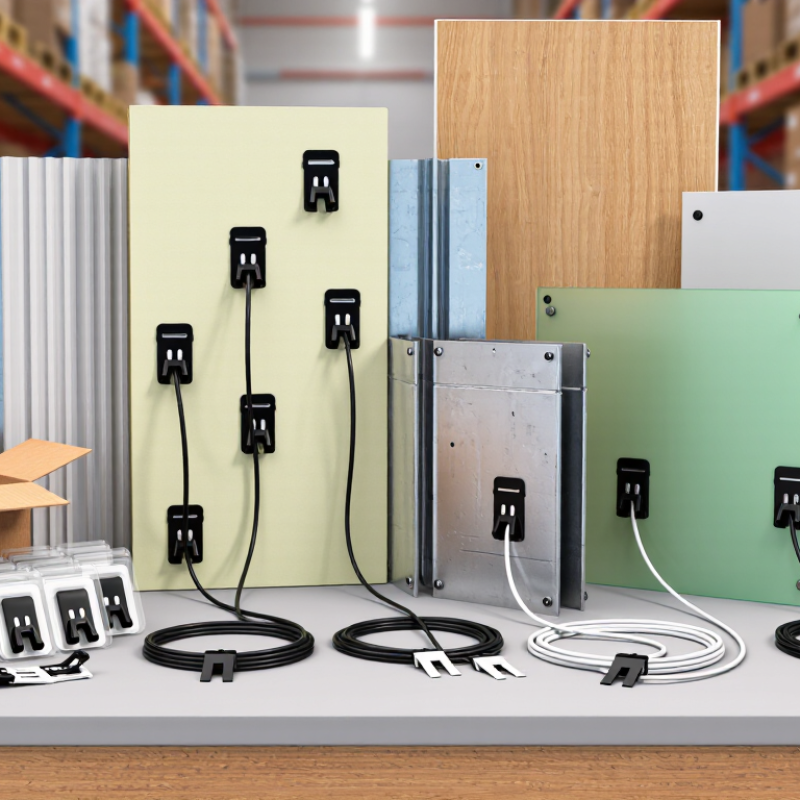
Self-adhesive cable clips are small routing tools, not merely plastic holders. Each clip combines a molded base, a cable channel, and pressure-sensitive adhesive. Pressing the clip onto a clean surface creates contact. The adhesive then slowly “wets out” tiny surface irregularities. This process improves holding strength over time.
In warehouse testing, surface preparation often determines success more than clip size. Dust, oil, textured paint, and cold temperatures can reduce adhesion. A clip may feel secure immediately, yet fail after several hours under cable weight. Fortune Business Insights reported that the global cable management market reached USD 23.33 billion in 2023. That scale reflects growing demand for organized wiring in offices, homes, vehicles, and industrial spaces. However, market growth does not make every adhesive clip suitable for every application. Load limits, temperature ranges, cable diameter, and removal behavior still require checking.
Tips: Clean surfaces with a suitable alcohol wipe, then let them dry fully. Press firmly for 30 seconds. Wait before loading the cable. For wholesale buyers, request peel-strength data, aging results, and sample batches. Compare performance on painted metal, glass, plastic, and wood. Packaging claims can sound confident. They are not testing data. A practical trial is wiser.
Some clips also use reusable hinges or flexible saddles. These features speed installation and maintenance. I have found that oversized clips often look safer but may loosen sooner. Better fit usually matters more than bulk. Industry purchasing teams should record failed samples, not hide them. That uncomfortable evidence improves the next order.
Wholesale demand is rising with organized wiring. Grand View Research valued the global cable management market at about USD 23.4 billion in 2023, with a projected 7.6% CAGR through 2030. Buyers should compare more than unit price. Adhesive quality, material stability, and packaging directly affect return rates.
Start with the backing adhesive. Check peel strength on painted metal, glass, plastic, and powder-coated surfaces. ASTM D3330 offers a useful peel-adhesion testing method, but it does not fully predict field performance. Ask for test results after heat, humidity, and storage aging. A clip that holds one cable may fail under a bundled load. Load matters.
Not all plastics behave alike. Nylon often offers better toughness, while flame-retardant polymers may suit electrical installation environments. Review temperature limits, UV resistance, cable-opening size, and base thickness. The adhesive pad should sit flat, without exposed edges or wrinkles. Small details matter. Packaging also deserves attention: clean bags, readable batch codes, and consistent clip counts simplify warehouse control. I would still sample-test every production lot, because supplier data can look perfect while surface preparation remains inconsistent. A higher adhesive rating is not automatically better. The application surface decides much of the result.
For wholesale buyers, the 10 best self-adhesive cable clips are not chosen by appearance alone. They should hold common cable sizes, resist heat, and attach firmly to clean surfaces. Useful options include single-wire clips, twin-wire clips, flat-base clips, adjustable clips, screw-assisted clips, and low-profile clips. Larger models suit power cords, while compact models fit charging cables and data lines. A practical range should cover several sizes.
Material matters during inspection. Nylon clips usually offer good flexibility and insulation, while stronger polymer blends can handle heavier cables. The adhesive pad should remain stable on painted metal, glass, plastic, and sealed wood. However, one pad may not perform equally on every surface. Dust, oil, and textured paint can reduce grip quickly. Clean the area with a suitable surface cleaner, then allow it to dry before testing.
Wholesale buyers should request samples before placing a large order. Load each clip with the intended cable, then check movement after 24 and 72 hours. Test warm areas, such as behind monitors or near equipment vents. Not every “strong” adhesive performs well in real conditions. That is worth admitting. Packaging should show size, material, cable capacity, application limits, and storage guidance. Consistent molding also matters because uneven edges can damage soft insulation. A reliable supplier should provide inspection records, batch information, and responsive answers about adhesive performance. Small details prevent expensive returns.
Choosing the 10 best self-adhesive cable clips starts with the cable, not the clip. A 3–5 mm clip suits charging leads and sensor wires, while thicker power cables need wider saddles and stronger bases. According to Grand View Research, the global cable management market was valued at approximately USD 23.2 billion in 2023. That growth reflects demand for safer, cleaner installations across offices, vehicles, workshops, and data facilities.
Match each clip to its application. Smooth acrylic adhesive works well on clean metal, glass, and finished plastic. Textured walls, dusty cabinets, and warm machinery require mechanical fixing or higher-temperature adhesive. Check the cable’s weight, bending radius, and insulation before purchasing wholesale quantities. Polyamide clips offer useful heat resistance, while softer materials protect delicate data cables from pressure marks. Small details matter.
Indoor and outdoor use differ sharply. Moisture, sunlight, oil, and temperature changes can weaken adhesive quickly. IEC 60227 guidance helps buyers identify suitable insulated low-voltage cable types, but it does not guarantee adhesive performance.
One practical error is trusting the stated load rating without testing the actual surface. Peel tests, 24-hour bonding checks, and sample trials reduce costly returns. Ten clip styles may look excessive, yet a narrow range can create poor fits, cable strain, and untidy routing. Procurement should include spare sizes. That part is easy to overlook.
10 Best Self Adhesive Cable Clips for Wholesale Buyers
Wholesale buyers should evaluate more than the unit price. Grand View Research reported that the global cable management market was valued at approximately USD 16.8 billion in 2022. It also projects steady growth through 2030. This demand increases supplier pressure, but low prices can hide weak adhesive, inconsistent molding, or poor packaging. Request tiered quotations for 1,000, 5,000, and 10,000 pieces. Compare landed cost, not only factory price.
Quality control needs measurable checkpoints. Ask for adhesive type, backing thickness, holding capacity, temperature range, and aging-test results. Test samples on painted steel, glass, and textured plastic. Leave them for 72 hours before applying a light cable load. Some clips pass a short test, then loosen overnight. That detail matters. The ISO Survey 2022 recorded more than 1.2 million ISO 9001 certificates worldwide, yet certification alone does not prove product consistency. Request batch records, inspection photos, and corrective-action reports.
Supplier evaluation should include production capacity, lead time, replacement policy, and traceability. The World Bank’s 2023 Logistics Performance Index shows clear differences in customs, delivery reliability, and shipment tracking across markets. Ask suppliers to explain their packaging method and reorder process. A useful scorecard can assign 30% to quality, 25% to total cost, 20% to delivery, and 15% to communication. The remaining 10% should cover flexibility. That weighting may need revision after the first shipment. Procurement teams often underestimate handling damage and adhesive failure. Expect evidence, not promises.
| Rank | Clip Type | Recommended Cable Capacity | Typical Material | Adhesive System | Typical Size | Indicative Bulk Price (USD/1,000 pcs) |
Common MOQ (pcs) |
Key Quality-Control Checks | Supplier Evaluation Score / 100 |
Best Wholesale Use |
|---|---|---|---|---|---|---|---|---|---|---|
| 1 | Single-hole square clip | 1 cable up to 6 mm diameter | Injection-molded nylon or ABS | Acrylic foam adhesive pad | 20 × 20 mm | $18–$32 | 5,000 | Pad adhesion, clip integrity, dimensional tolerance, surface cleanliness | 94 | Office, home, and light electronics packaging |
| 2 | Low-profile cable holder | 1–2 cables up to 5 mm each | Flexible PVC or nylon | Rubber-based pressure-sensitive adhesive | 25 × 15 mm | $16–$29 | 5,000 | Release liner quality, peel strength, flex-fatigue resistance, adhesive coverage | 92 | USB, charging, and audio cable organization |
| 3 | Double-cable saddle clip | 2 cables up to 8 mm each | UV-stabilized polypropylene | Acrylic adhesive pad | 35 × 20 mm | $24–$42 | 3,000 | Load retention, spacing accuracy, UV exposure resistance, pad alignment | 90 | Retail multipacks and workstation cable kits |
| 4 | Rotating cable clip | 1 cable up to 7 mm diameter | ABS body with nylon swivel | High-tack acrylic foam pad | 28 × 22 mm | $31–$52 | 2,000 | Rotation torque, hinge cycle testing, adhesive shear, molding flash | 88 | Adjustable desk and monitor cable routing |
| 5 | Heavy-duty locking clip | 1 cable bundle up to 12 mm | Nylon 6 or reinforced polypropylene | Industrial acrylic adhesive | 40 × 30 mm | $48–$78 | 1,000 | Static load, latch strength, temperature cycling, adhesive shear resistance | 87 | Automotive accessories and light industrial installations |
| 6 | Transparent mini clip | 1 cable up to 4 mm diameter | Clear polycarbonate or acrylic | Clear acrylic adhesive | 15 × 15 mm | $22–$39 | 5,000 | Optical clarity, yellowing resistance, edge finish, peel adhesion | 86 | Glass, display fixtures, and premium consumer packaging |
| 7 | Multi-slot cable organizer | 3–5 cables up to 6 mm each | Silicone or soft TPE | Acrylic adhesive backing | 60 × 30 mm | $55–$95 | 1,000 | Slot retention, silicone hardness, tear resistance, adhesive bond area | 85 | Home-office kits and consumer electronics bundles |
| 8 | Corner-mounted cable clip | 1–2 cables up to 6 mm each | ABS or flame-retardant nylon | High-tack foam adhesive | 30 × 30 × 18 mm | $28–$49 | 3,000 | Angle accuracy, corner fit, flame-retardant documentation, pad placement | 83 | Furniture, shelving, and interior cable management |
| 9 | Outdoor weather-resistant clip | 1 cable or tube up to 10 mm | UV-resistant nylon or ASA | Outdoor-grade acrylic adhesive | 35 × 25 mm | $62–$105 | 1,000 | UV aging, humidity exposure, temperature cycling, water ingress, load retention | 82 | Outdoor lighting, signage, and low-voltage installations |
| 10 | Removable adhesive cable clip | 1 cable up to 5 mm diameter | ABS or flexible polypropylene | Removable gel or low-residue adhesive | 22 × 18 mm | $35–$60 | 2,000 | Clean removal, residue testing, repeat adhesion, clip fatigue, pad consistency | 80 | Rental properties, temporary displays, and event equipment |
Reference note: Bulk prices and MOQs are indicative wholesale ranges for standard, unbranded products and may vary by material, adhesive grade, packaging, testing requirements, order quantity, and destination. Supplier evaluation scores combine product suitability, quality-control transparency, customization capability, MOQ flexibility, lead-time reliability, and documentation readiness.